
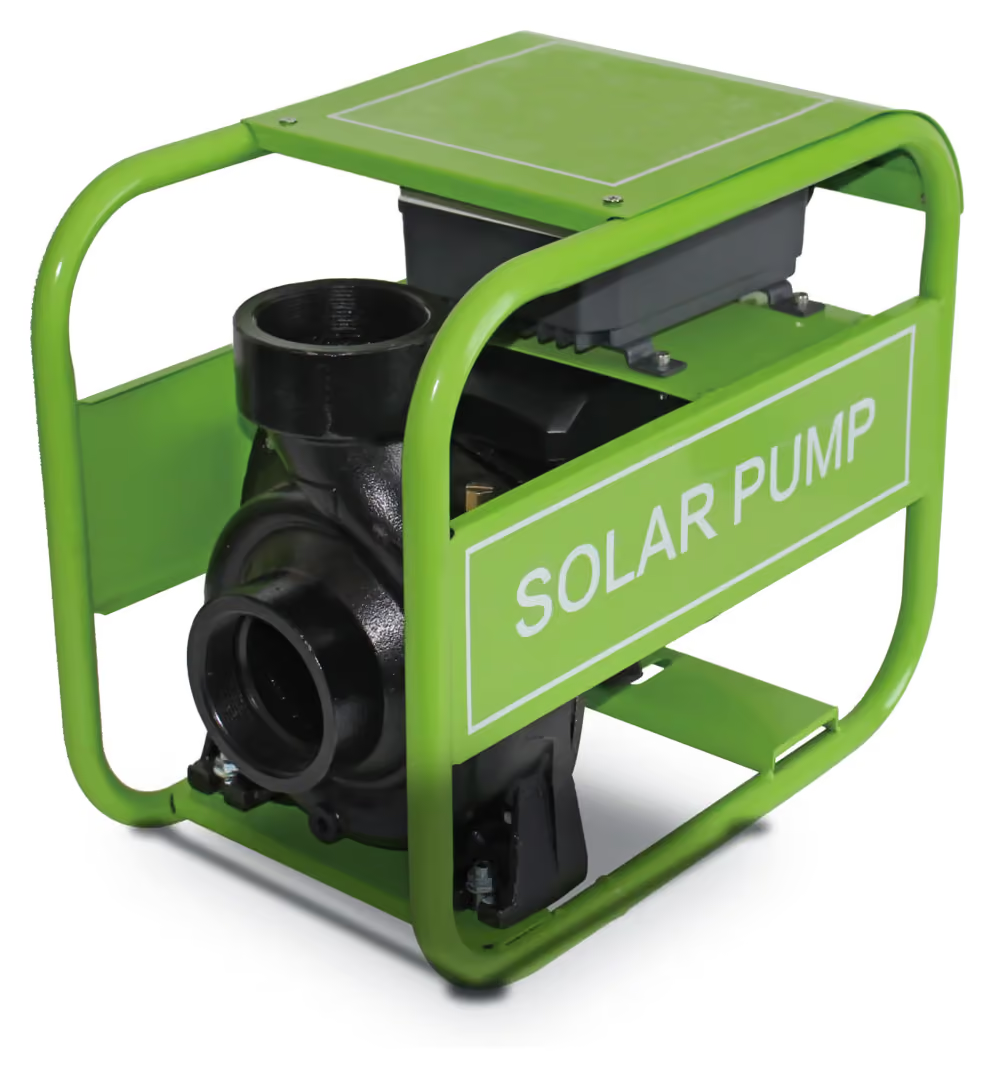
Rakour · 48V DC Solar Peripheral Regenerative Vortex Surface Pump
48V DC Solar Peripheral Vortex Surface Pump (550W, 50m, 3.0 m³/h)
Model DQB3-50-48-550
High-head 48V DC solar peripheral vortex pump with 550W motor, 50m maximum head, and 3.0 m3/h maximum flow. Regenerative brass vortex impeller with anti-seizure casing inserts, ideal for clean water boosting, high-elevation storage tanks, and uphill pipelines.
- Pump Architecture
- Peripheral Regenerative Vortex Pump Machined brass peripheral impeller with anti-seizure front casing inserts
- Rated DC Voltage
- 48V DC Optimum MPPT input window between 60V and 90V DC
- Rated Motor Power
- 550W Brushless DC permanent magnet synchronous motor (BLDC)
- Maximum Vertical Head
- 50m (164 ft) Steep head-capacity curve generating high pressure from low wattage
- Maximum Flow Rate
- 3.0 m3/h (50 L/min) Supplies 12,000 to 20,000 liters per sunny agricultural day
- Suction & Discharge Ports
- 1 in x 1 in (25 mm) Standard female NPT/G threaded connection ports
Product overview
High-head 48V DC solar peripheral vortex pump with 550W motor, 50m maximum head, and 3.0 m3/h maximum flow. Regenerative brass vortex impeller with anti-seizure casing inserts, ideal for clean water boosting, high-elevation storage tanks, and uphill pipelines.
Model DQB3-50-48-550
48V DC Solar Peripheral Regenerative Vortex Surface Pump
- Pump Architecture
- Peripheral Regenerative Vortex Pump
- Rated DC Voltage
- 48V DC
- Rated Motor Power
- 550W
- Maximum Vertical Head
- 50m (164 ft)
Hydraulic & Mechanical Performance
Empirical head and flow rates measured across standard 48V DC operating conditions. Demonstrates exceptional pressure generation from compact dimensions.
- Engineered exclusively for clean, non-abrasive water free of suspended sand or coarse gritty particles.
- Always prime the pump volute chamber completely through the top plug before initiating operation.
Electrical & Solar Parameters
Two series-wired panels providing the ideal 60V-90V DC operating window required for the 48V BLDC motor.
- Rated Voltage 48V DC
- Optimum MPPT Range 60V to 90V DC
- Motor Design Totally Enclosed Fan Cooled (TEFC) Brushless DC (BLDC)
Product features
Peripheral Regenerative Vortex Impeller
Precision milled brass impeller with numerous peripheral radial blades recirculates fluid through an annular channel, generating 50m head from only 550W.
Anti-Seizure Brass Casing Inserts
Inlaid brass wear plates eliminate electrochemical bonding between the brass impeller and cast-iron casing after long seasonal winter shutdowns.
Steep Head-Capacity Hydraulic Curve
Delivers strong dynamic pressure across steep elevation gradients, making it ideal for uphill water transport and multi-story domestic booster duties.
Energy-Dense Brushless DC Drive with TEFC Cooling
Permanent magnet BLDC motor equipped with an external cooling fan and aerodynamic heat-dissipation fins ensures cool operation in tropical climates.
Hydraulic performance
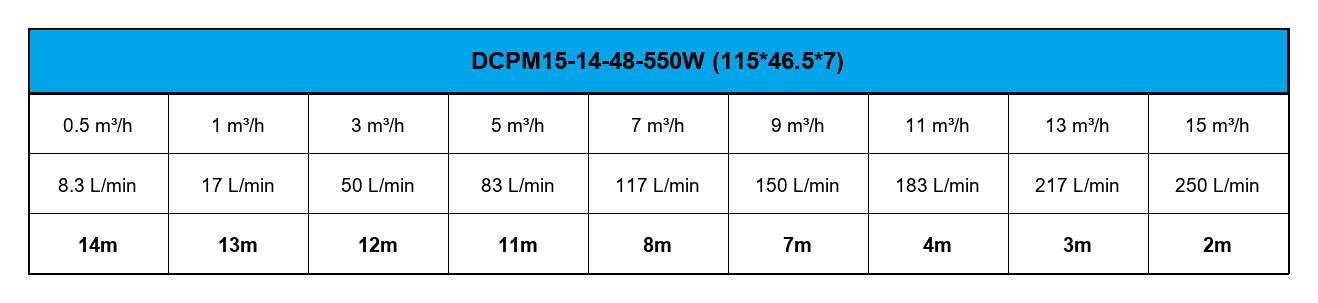
DQB3-50-48-550 Hydraulic Performance Working Points
Empirical head and flow rates measured across standard 48V DC operating conditions. Demonstrates exceptional pressure generation from compact dimensions.
- Engineered exclusively for clean, non-abrasive water free of suspended sand or coarse gritty particles.
- Always prime the pump volute chamber completely through the top plug before initiating operation.
Operating Head vs Flow Duty Matrix
| Operating Head (TDH) | Discharge Flow Rate | Recommended Duty Scenario |
|---|---|---|
| 15m | 2.9 m3/h | Low-elevation storage tank replenishment & open cistern filling Near-maximum volumetric discharge with reduced pipeline resistance |
| 28m | 2.3 m3/h | Uphill pipeline water transfer & orchard micro-sprinkling Optimum balance between operating pressure and solar power conversion |
| 40m | 1.5 m3/h | Multi-story farmstead boosting & steep slope delivery Consistent high-pressure discharge overcoming significant static elevation |
| 48m | 0.6 m3/h | High-elevation summit tank feeding near shutoff limit High-head threshold operation near 50m maximum shutoff head |
Technical specifications
Electrical & Solar Parameters
Hydraulic & Mechanical Performance
Materials & Structural Standards
Photovoltaic Sizing & Matching
Solar Array Sizing Guide
- Verify that cold-weather open-circuit voltage (Voc) remains safely below 120V DC at lowest recorded site temperatures.
- Install an external DC circuit breaker and lightning surge protection device (SPD) ahead of the controller input.
Global B2B Logistics
Packaging & Logistics
- Packaging Format
- Export Reinforced Wooden Case
- Crate Dimensions (L×W×H)
- 350 x 280 x 228
- Volume (CBM)
- 0.0238
- Gross / Net Weight
- 10.18 / 8.64
- Customs HS Code
8413709990
Standard Package Contents
- Rakour DQB3-50-48-550 solar peripheral vortex booster pump unit
- External IP65-rated intelligent MPPT solar pump controller
- 1-inch brass foot valve with stainless steel debris strainer
- 1-inch threaded hose connector fittings and sealing gaskets
- Waterproof heat-shrink tubing and terminal wire connection kit
- Illustrated technical installation and maintenance manual
Rakour Engineering Field Sizing
Engineering In-Depth Analysis
Advanced 48V DC Solar Peripheral Vortex Pumping Technology for High-Head Water Delivery
The Rakour DQB3-50-48-550 is an engineered 48V DC solar peripheral regenerative vortex surface pump specifically developed for agricultural and rural applications requiring high vertical head and steady pressure from compact electrical power. Conventional horizontal centrifugal pumps require substantial motor power and multi-stage impellers to reach heads beyond 30 meters. In contrast, the DQB3-50-48-550 employs regenerative vortex hydraulics that recirculate fluid repeatedly within an annular peripheral channel, producing an extraordinary maximum head of 50 meters (71 psi) from a modest 550W power draw.
Driven directly by a high-efficiency brushless DC (BLDC) permanent magnet synchronous motor, this pump converts raw photovoltaic energy into dynamic hydraulic pressure without requiring battery banks, utility grid connections, or fossil-fuel generators. Discharging up to 3.0 m³/h (50 liters per minute) and delivering 12,000 to 20,000 liters of pressurized water per sunny agricultural day, the DQB3-50-48-550 is the premier technical choice for pushing clean water uphill to ridge-top storage tanks, boosting domestic line pressure in off-grid homesteads, and overcoming extensive friction across long-distance distribution pipelines.
Regenerative Vortex Hydrodynamics, Brass Peripheral Impeller & Anti-Seizure Engineering
The operational distinction of the DQB3-50-48-550 lies in its peripheral impeller hydrodynamics. Unlike conventional open or closed centrifugal impellers, the peripheral impeller is a solid, precision-machined brass disc featuring dozens of small radial vanes arranged along its outer perimeter. As the impeller rotates within the close-fitting concentric casing channel, fluid enters the peripheral vanes and is subjected to intense centrifugal force. Rather than exiting directly to the discharge port, the fluid is repeatedly thrown outward and swept back into adjacent vanes by the annular casing contour. Each regenerative recirculation cycle imparts an incremental velocity boost, compounding pressure along the circumference until the liquid exits the discharge port at high static head.
Because peripheral hydraulics rely on minimal mechanical clearances (often under 0.15 mm) between the impeller and side walls, traditional cast-iron peripheral pumps suffer from impeller seizure when left idle across winter seasons due to electrochemical oxidation. Rakour eliminates this common failure by incorporating integrated brass anti-seizure wear plates within the casing face. These non-ferrous inserts prevent galvanic bonding between the brass impeller and the cast-iron casing, ensuring smooth, instantaneous rotation upon seasonal reactivation. The outer casing is protected by a cathodic electrophoretic coating that prevents rust, while the rotating shaft is hermetically sealed by an industrial silicon carbide (SiC) mechanical face seal.
Solar Surface Architecture Spectrum: Peripheral Vortex vs. Self-Priming Jet vs. Volute Centrifugal
Matching pump architecture to operational head and fluid characteristics ensures system reliability and prevents equipment mismatch:
- High-Head Clean Water Specialist: The DQB3-50-48-550 is the optimal solution when pushing clean water to steep elevations (up to 50m head) or across long pipelines with low power consumption.
- Dedicated Surface Pumping Collection: Explore our comprehensive solar surface pumps category to evaluate peripheral, jet, and centrifugal models.
- Deep-Suction Self-Priming Jet Alternative: When drawing water from depths down to 9 meters where air bubbles may enter, the DJET2.7-45-48-550 self-priming jet pump is ideal.
- Massive-Volume Low-Head Centrifugal Specialist: When transferring large water volumes from canals and ponds with minimal head, our DCPM21-14-72-750 delivers up to 21 m³/h.
- 3-Inch Borehole Submersible Alternative: When water resides in narrow 3-inch boreholes down to 35 meters, our multi-stage 3DPC3.5-35-24-300 provides subterranean pumping.
- Deep-Aquifer Progressive Cavity Specialist: For deep groundwater extraction up to 100 meters, consider the 3DSS1.7-100-48-500 helical screw pump.
- Complete Technology Matrix: Browse our full portfolio of solar water pumps to analyze performance curves across all submersible and surface pumping categories.
- Systematic Selection Framework: Utilize our comprehensive pump selection guide to compute total dynamic head (TDH), pipe friction losses, and required pump duty points.
Clean Water Fluid Dynamics, NPSH Suction Guidelines & Seasonal Maintenance
Operating a peripheral regenerative pump requires strict adherence to fluid purity standards. Due to the ultra-tight internal clearances that generate its steep pressure curve, the DQB3-50-48-550 is designed exclusively for clear, non-abrasive water. Pumping water with suspended abrasive sand, grit, or heavy silt will rapidly erode the brass vanes and casing channel, causing permanent pressure degradation. If abstracting from open rivers or sediment-prone basins, install a fine-mesh cartridge or disc filter upstream of the suction inlet.
The suction pipeline must be constructed from rigid 1-inch (25mm) pipe equipped with a high-flow brass foot valve. Practical suction lift should be limited to 5.0 to 6.0 meters, positioning the pump as close as possible to the water source to maintain adequate Net Positive Suction Head (NPSH). Prior to initial startup, remove the top priming plug and fill the casing completely with water to purge all air. Before seasonal freezing temperatures occur, unthread the bottom drain plug to evacuate trapped water, preventing catastrophic frost cracking of the cast-iron pump chamber.
High-Elevation Irrigation & Domestic Pressurization System Integration
When integrating the DQB3-50-48-550 into agricultural infrastructure or off-grid homesteads, follow the holistic engineering methodologies detailed in our solar irrigation systems for farms technical guide.
The supplied IP65-rated intelligent MPPT controller tracks fluctuating solar radiation dynamically, optimizing motor speed from 1,000 to 3,500 RPM to maximize water delivery under changing sunlight. The controller features built-in dry-run protection, motor thermal management, and dedicated input terminals for pressure switches and storage tank float switches. Coupled with a small diaphragm pressure vessel and pressure switch, the DQB3-50-48-550 functions as a fully automated booster system, starting automatically upon faucet demand and shutting down when line pressure is restored, delivering effortless utility-grade water independence.
Recommended applications
High-Elevation Storage Tank Pumping
Overcomes severe static elevations up to 50 meters, pushing water up steep hillsides to summit gravity storage tanks.
Off-Grid Domestic Water Pressure Boosting
Generates household tap pressure for remote farmhouses, eco-lodges, and cabins directly from rooftop solar arrays.
Long-Distance Pipeline Water Transfer
Drives water through hundreds of meters of horizontal small-bore pipe where hydraulic friction would stall ordinary pumps.
Clean Cistern & Shallow Well Water Abstraction
Pumps from rainwater harvesting cisterns, spring collection boxes, and shallow dug wells free of suspended sand.
System configuration
-
High-Efficiency Monocrystalline Solar Array
Two series-wired panels providing the ideal 60V-90V DC operating window required for the 48V BLDC motor.
-
Intelligent External MPPT Surface Controller
Continuous peak power tracking with integrated low-water protection, thermal sensing, and pressure switch inputs.
-
Suction Assembly with Brass Foot Valve
Non-collapsible 1-inch suction line with check valve maintaining permanent priming for automatic daily startups.
Installation notes
- Ensure water source is clean; install an upstream sediment filter if pumping from sources with occasional particulate matter.
- Fill the pump casing completely with water through the top priming plug before switching on electrical power.
- Before winter freeze events, remove the bottom casing drain plug to evacuate water and prevent frost damage.
Product FAQ
Review verified technical data, operating limits and the project information needed to evaluate this model.
How does a peripheral vortex pump differ from a standard centrifugal pump?
A centrifugal pump uses a wide impeller to impart radial kinetic energy, producing high flow at lower heads. In contrast, a peripheral (regenerative vortex) pump utilizes a brass wheel with numerous radial peripheral vanes rotating inside an annular channel. Liquid recirculates repeatedly between the impeller blades and the channel, gaining energy cumulatively and generating unusually high discharge heads (up to 50m) from compact dimensions.
Why are anti-seizure brass inserts essential on peripheral pumps?
Peripheral pumps require extremely tight clearances (fractions of a millimeter) between the impeller faces and casing to prevent internal pressure slippage. When cast-iron casings contact brass impellers during seasonal shutdowns, electrochemical corrosion can form oxide deposits that bind the impeller. Our inlaid brass anti-seizure plates eliminate this metal-to-metal bonding, ensuring effortless startup even after months of dormancy.
Can the DQB3-50-48-550 pump water containing sand or silt?
No. Peripheral pumps are precision machines engineered strictly for clean, clear water. Suspended sand, grit, or abrasive silt will quickly erode the tight clearances between the brass impeller and casing, causing rapid loss of pressure and head. For water sources with sand or sediment, our self-priming jet pump (DJET) or volute centrifugal pump (DCPM) is recommended.
What solar array sizing is recommended for this 48V 550W pump?
We recommend installing two 360W to 425W monocrystalline solar panels wired in series (2S). This configuration delivers an operating voltage (Vmp) between 68V and 76V, ideally matching the controller optimum MPPT input range (60V-90V DC) while keeping cold-weather open-circuit voltage safely below the 120V Voc cutoff.
How should the pump be winterized in cold climates?
Prior to sub-zero freezing weather, unscrew the drain plug at the base of the pump casing to drain all trapped water. Trapped water expands when freezing, which will fracture the cast-iron housing. Store the pump in a dry location or ensure the volute chamber remains completely emptied.
Related products
Project sizing support
Match this pump to your site
Share the water source, required flow, total head and pipe route. Rakour will help check the operating point.