
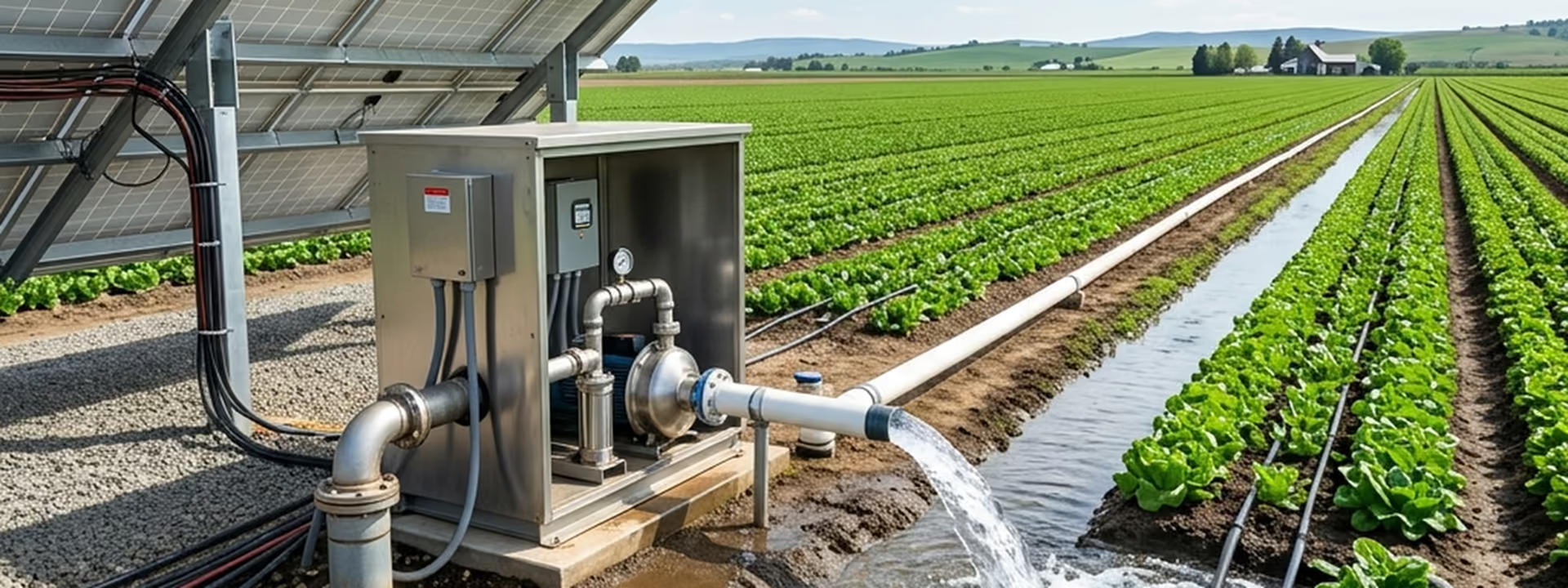
Agricultural irrigation
Solar Irrigation Systems for Farms
Calculate water demand and total dynamic head, then compare the duty point with verified Rakour pump limits.
Project overview
- Selection basis
- Required flow at total dynamic head
- Published examples
- Five Rakour pump models
- Hydraulic boundaries
- 1.5-15 m3/h max flow and 14-100m max head Catalogue maximums across different models, not simultaneous duty points.
- Delivery options
- Tank filling or direct irrigation
On this page
- Begin with the irrigation duty, not pump wattage
- A worked sizing example
- Calculate the complete pumping head
- Check changing site conditions
- Choose the delivery arrangement
- Pump into storage
- Supply irrigation directly
- Read Rakour product limits correctly
- Choose by source and duty
- Build the complete electrical and hydraulic system
- Prepare the project information
Begin with the irrigation duty, not pump wattage
A farm does not need a 200W, 500W or 1,000W pump as a starting point. It needs a known volume of water delivered to a defined point at a defined pressure. Rakour model data becomes useful only after those conditions are known.
Calculate net crop demand for the design season, multiply it by the irrigated area, then account for application efficiency. Existing drip or sprinkler systems should be checked by counting the emitters that operate in the largest simultaneous zone.
Gross daily volume = irrigated area x net crop demand / application efficiency
The hourly pump target is the gross daily volume divided by realistic pumping hours, not simply the number of daylight hours. Morning and late-afternoon irradiance may be insufficient for full output, and seasonal conditions matter.
Pump wattage is not a duty point. Record the required flow in m3/h and the total dynamic head in metres before comparing models.
A worked sizing example
This is a calculation example, not a Rakour project claim or a model recommendation.
The gross daily requirement is 5,000 x 0.0035 / 0.90 = 19.4 m3/day. Dividing by six productive pumping hours gives a target flow of approximately 3.2 m3/h.
Now assume a 7m pumping water level, a 5m rise to the tank and 3m of calculated pipe and fitting losses. The initial duty point is therefore 3.2 m3/h at 15m total dynamic head.
This result can screen the published range, but it cannot confirm a model. For example, the Rakour 3DPC3.5-35-24-300 lists 3.5 m3/h maximum flow and 35m maximum head. Those two maximums occur at different ends of the curve. The current curve must show whether 3.2 m3/h is available at 15m.
Calculate the complete pumping head
Total dynamic head combines the vertical lift from the pumping water level, elevation to the delivery point, friction through the complete pipe route and pressure required at the final outlet.
| Design input | What to confirm | Why it matters |
|---|---|---|
| Pumping water level | Expected water level while the pump is running | The standing water level can underestimate the real lift |
| Delivery elevation | Vertical distance to the tank or field inlet | Elevation becomes direct static head |
| Pipe route | Internal diameter, length, fittings and valves | Long or narrow pipe increases friction loss |
| Field pressure | Minimum pressure required by the irrigation equipment | The pump must still provide this pressure after every other loss |
Check changing site conditions
Review more than one condition. A borehole may draw down during pumping, filters add resistance as they collect debris, and different irrigation zones may demand different flows. Check the useful part of the curve at the lowest and highest expected head instead of designing around one optimistic value.
For surface pumps, do not treat maximum head as permission for any suction arrangement. Suction lift, priming, inlet losses and the water source geometry must be verified separately against the approved product information.
Choose the delivery arrangement
The delivery arrangement changes the pump duty. Decide this before requesting a model comparison.
Pump into storage
A storage tank allows the pump to collect water during productive daylight while irrigation operates at another time or at a steadier rate. This can remove sprinkler or drip pressure from the pumping duty when a separate delivery method supplies that pressure.
The tank elevation can also provide gravity pressure where the available height and irrigation requirement are compatible. Tank volume, structural support and overflow management must be included in the project design.
Supply irrigation directly
Direct pumping can reduce storage, but the pump must supply both flow and field pressure while solar input changes. Confirm the minimum operating pressure of emitters, filters and regulators. Zone valves should not leave the pump operating against excessive pressure or below its useful flow range.
Read Rakour product limits correctly
The published Rakour range on this site includes submersible and surface examples with different hydraulic purposes. The model table below is generated from the current product records, so the displayed voltage, power, maximum flow and maximum head remain tied to those records.
The 2DPC and 3DPC examples use a 24V DC platform. Their published optimum input range is 30V to 48V, and array open-circuit voltage must remain below 60V. The 3DSS, 4DSC and DCPM examples use a 48V DC platform with a published optimum input range of 60V to 90V and open-circuit voltage below 120V.
These are limits for the models referenced on this page, not a universal rule for every Rakour product. Module configuration must remain within the selected controller limits at the expected operating temperature and at the coldest expected open-circuit condition.
Choose by source and duty
- Use a submersible model only after confirming bore or casing diameter, pumping level, required submergence and installation clearance.
- Evaluate a surface centrifugal model for an accessible source only after confirming the complete suction condition and priming arrangement.
- A high-head screw pump and a high-flow surface pump solve different problems. Motor wattage alone does not make them substitutes.
- Treat outlet size and supplied cable length as installation inputs, not minor accessories.
Build the complete electrical and hydraulic system
After a pump passes the duty-point check, size the solar array and electrical path around the published input window. Check module operating voltage, cold open-circuit voltage, cable length, voltage drop, isolation, earthing and protection required by the installation.
Dry-run protection and water-level controls should reflect the source. Pipe diameter should be selected from target flow, route length and acceptable friction rather than copied from the pump outlet. A small outlet does not justify carrying the same diameter through a long delivery route.
Prepare the project information
For a Rakour selection request, record measured values where possible:
- Water source type and available bore or pump installation dimensions.
- Static and expected pumping water levels.
- Required daily water volume and target operating flow.
- Delivery elevation, pipe length, internal diameter and major fittings.
- Minimum pressure required at the irrigation inlet.
- Project location, seasonal operating period and available solar area.
- Storage volume or direct-irrigation schedule.
- Available module specifications and installation area, if panels are already selected.
When comparing alternatives, keep the duty point unchanged and record every assumption. If water level, pipe diameter or field pressure is unknown, mark it as unknown rather than replacing it with an unexplained safety factor.
The useful outcome is not simply a model number. It is a model number tied to a stated flow, total dynamic head, input-voltage window and delivery arrangement that can be checked before ordering.
Published Rakour pump data for initial screening
These current product records show the range of hydraulic and electrical limits represented on the site. Use them to narrow the pump type, then verify the required flow at total dynamic head on the current performance curve.
2DPC1.5-35-24-200
2-Inch 24V DC Solar Submersible Pump
- Rated voltage
- 24V DC
- Rated power
- 200W
- Maximum flow
- 1.5 m3/h
- Maximum head
- 35m
3DPC3.5-35-24-300
24V Solar Submersible Pump
- Rated voltage
- 24V DC
- Rated power
- 300W
- Maximum flow
- 3.5 m3/h
- Maximum head
- 35m
3DSS1.7-100-48-500
48V Solar Screw Pump
- Rated voltage
- 48V DC
- Rated power
- 500W
- Maximum flow
- 1.7 m3/h
- Maximum head
- 100m
4DSC3.5-50-48-400
48V Solar Submersible Pump with Stainless Steel Impeller
- Rated voltage
- 48V DC
- Rated power
- 400W
- Maximum flow
- 3.5 m3/h
- Maximum head
- 50m
DCPM15-14-48-550
48V Solar Surface Pump
- Rated voltage
- 48V DC
- Rated power
- 550W
- Maximum flow
- 15 m3/h
- Maximum head
- 14m
Maximum flow and maximum head are catalogue boundaries. They are not one simultaneous operating point and do not replace a verified pump curve.
Frequently asked questions
Can a solar pump run irrigation directly without a storage tank?
Yes, when the irrigation network can accept changing flow and the available solar window matches the watering schedule. A tank is often useful when demand must remain steady or irrigation takes place outside strong daylight hours.
How is the required pump size calculated?
Convert gross daily water demand into an hourly flow using realistic solar pumping hours. Add pumping level, delivery elevation, pipe friction and required outlet pressure to obtain total dynamic head. The required flow at that head must then be checked on the current pump curve.
Does pump power determine how much land can be irrigated?
Not by itself. Irrigated area depends on crop demand, irrigation efficiency, water availability, pumping head, system pressure, pipe losses and productive solar hours.
Which Rakour pump types are shown on this page?
The published examples include 2DPC, 3DPC, 3DSS and 4DSC submersible models plus the DCPM centrifugal surface pump. They represent different source conditions and hydraulic boundaries, not interchangeable recommendations.
Do maximum flow and maximum head occur together?
No. They are opposite catalogue boundaries. A model listed at 3.5 m3/h maximum flow and 35m maximum head is not confirmed to deliver 3.5 m3/h at 35m. Use the current performance curve for the actual duty point.
What project information should be prepared for selection?
Provide the source type, bore or casing diameter where relevant, static and pumping water levels, daily volume, target flow, delivery elevation, pipe length and diameter, required pressure, location and operating schedule.
Send Rakour the duty point, not only the pump power
Share the measured source level, daily volume, target flow, total lift, pipe route and irrigation pressure for a focused model review.